
ARR
Annual Recurring Revenue — recurring proceeds normalized to a yearly amount.
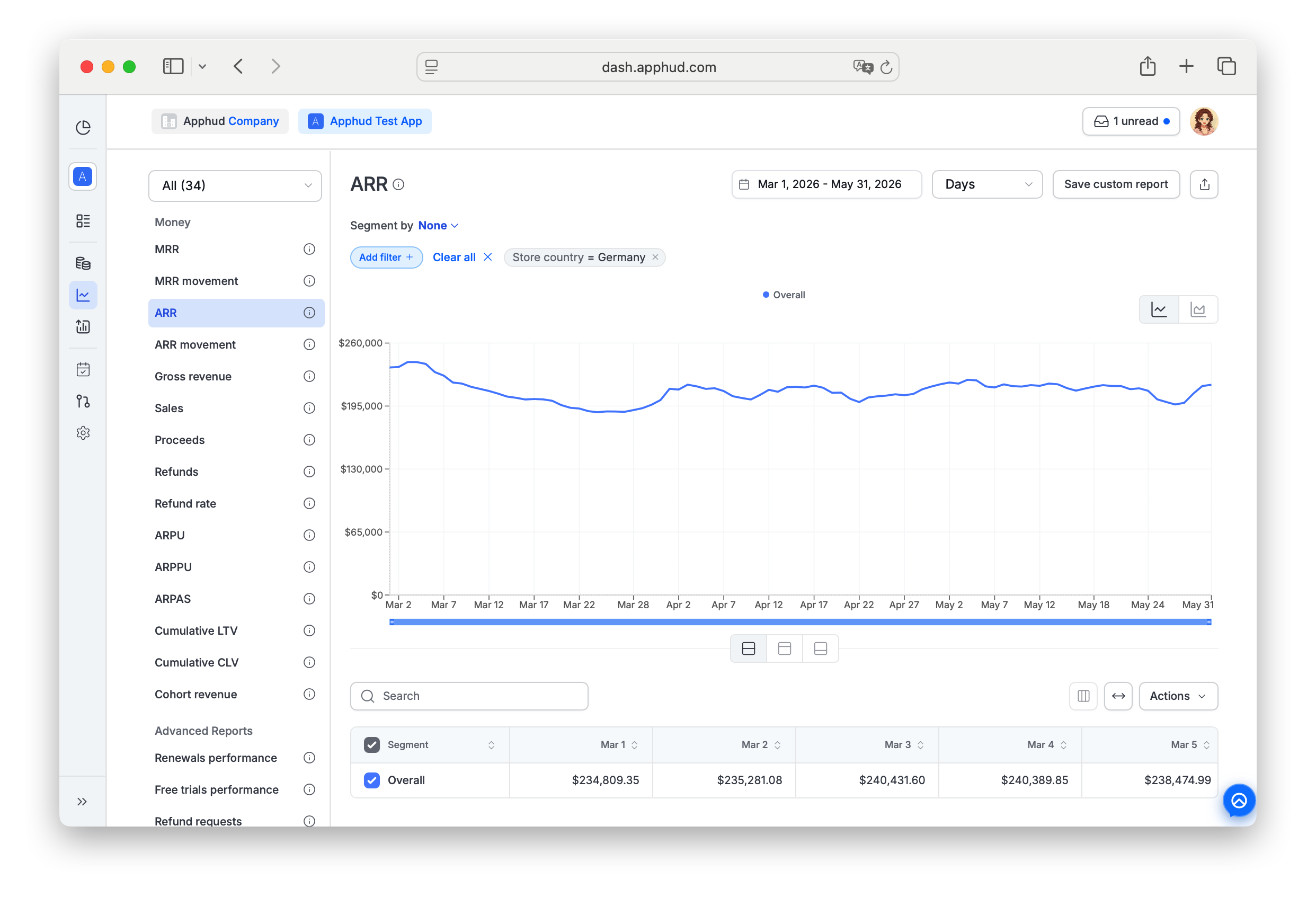
ARR (Annual Recurring Revenue) represents recurring proceeds revenue normalized to a yearly amount, after deducting the respective app store's commission and VAT.
ARR is roughly MRR × 12. It applies the same calculation rules and the same Proceeds-based normalization as MRR, but expressed as a yearly run-rate instead of a monthly one.
ARR ≈ MRR × 12
Find ARR under Analytics → Reports → Money in the sidebar.
Based on ProceedsThe ARR chart is calculated on the Proceeds metric. For VAT and store-commission rules, see About Analytics.
Calculation
ARR follows the same normalization rules as MRR, expressed annually:
- An annual subscription costing $120/year contributes $120/year directly to ARR.
- A monthly subscription costing $10/month contributes $120/year (× 12) to ARR.
- A weekly subscription contributes its weekly proceeds × 52 to ARR.
Additional rules (same as MRR):
- Only active subscriptions count.
- Subscriptions with auto-renew off keep counting until they actually expire.
When to use ARR vs MRR
- Use MRR for month-over-month operational tracking, churn analysis, and short-horizon forecasting.
- Use ARR for board reporting, year-over-year comparisons, and run-rate communication to investors or leadership.
The two are mathematically equivalent (×12) — pick whichever framing the audience prefers.
Supported filters and segments
ARR supports all standard segments and filters documented in Reports → Filters and segments.
Filter-only (not available as Segment by):
- Permission group — segment support is planned, currently filter only.
- Screen
- Experiment variations
FAQ
Is ARR literally MRR × 12 every day?
Conceptually yes — Apphud calculates ARR from the same recurring-proceeds pool that drives MRR, just annualized. Small rounding differences may appear at high precision, but for any practical purpose ARR = MRR × 12.
Does ARR include one-time purchases?
No. ARR counts recurring revenue only — subscriptions on active billing. Non-renewable purchases (consumables, lifetime unlocks) don't contribute to ARR. For total revenue including one-time purchases, see Gross revenue or Proceeds.
Why does ARR look identical to MRR × 12 on my chart?
Because that's the calculation. The chart exists separately for audiences who prefer annual framing (board, investors), not because ARR computes anything different.
Updated 19 days ago