
Win Back Refunds Add-On
Auto-respond to App Store and Google Play refund disputes with consumption data to reduce refund losses by up to 70%. Self-enable in Rules.
The Win back refund requests add-on lets Apphud respond to refund disputes on your behalf. For iOS, that's an App Store refund request; for Android, it's a Google Play chargeback — a dispute the customer opened through their bank. Google Play's own self-service refunds, which customers request directly in the Play Store, aren't covered. When the store asks for input, Apphud sends consumption data automatically, helping it make a better-informed decision. Customers using this feature typically save up to 70% of monthly refund losses.
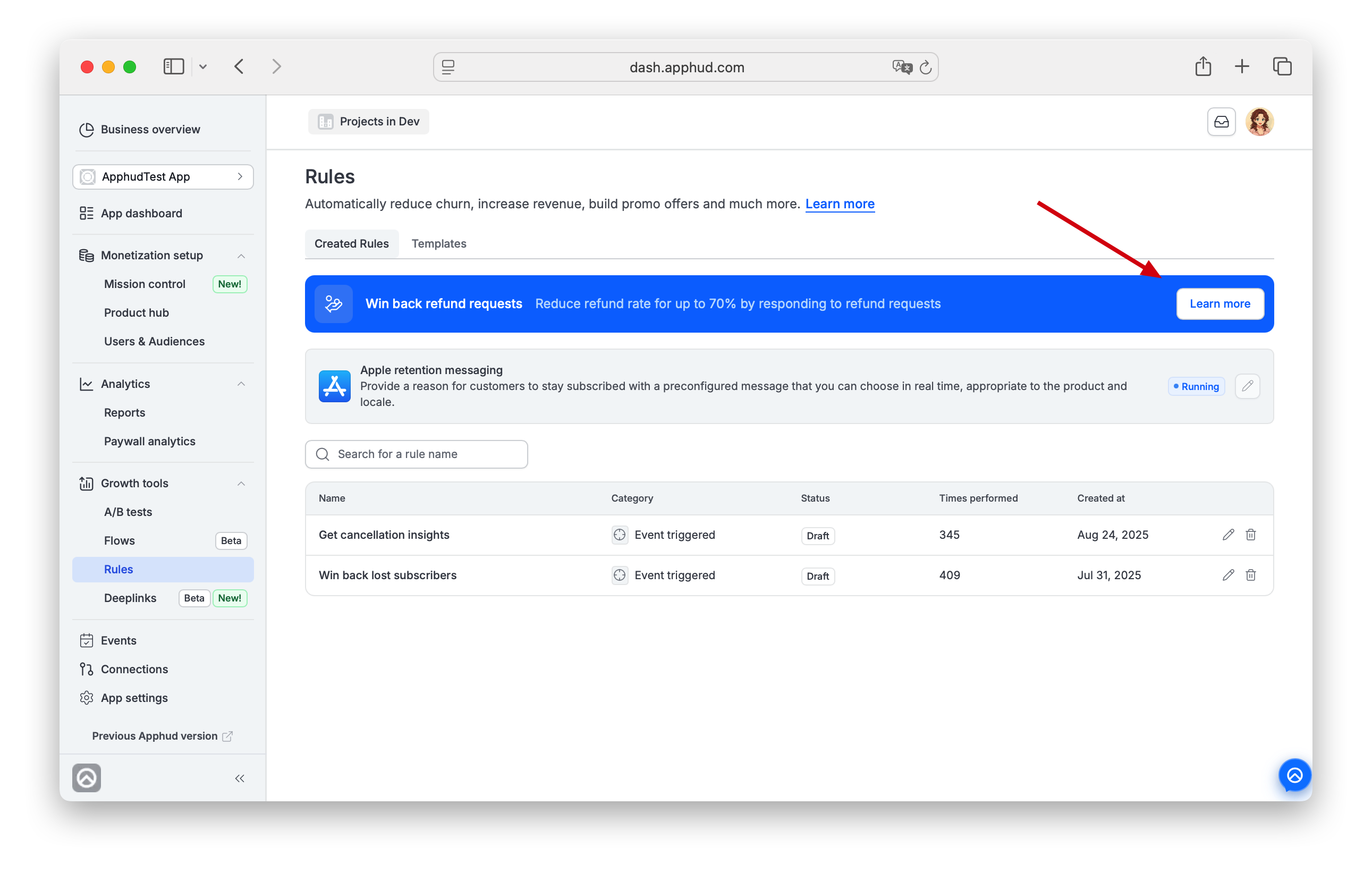
Find it in the left sidebar under Growth tools → Rules — featured at the top of the page as Win back refund requests.
Requirements
To use Win back refund requests, ensure all three prerequisites are met:
- App Store Server Notifications V2 are enabled. Activate Server Notifications V2 in your Apple Developer account and configure them within Apphud. See Server Notifications. Without V2, Apphud can't react to refund requests.
- Google Play Real-Time Developer Notifications are configured (for Android). Set up RTDN in Google Play Console and Apphud — see Server Notifications. Without it, Apphud can't react to Google's chargeback review requests.
- App Privacy Policy is updated. Your app's Privacy Policy, Terms & Conditions, or similar document must disclose consumption data collection and its purpose before enabling this feature. See Apple's App Privacy Details for guidance.
- User Consent for Data Sharing is obtained. Comply with Apple's requirements by securing valid user consent for sharing consumption data before enabling. As the app developer, you are responsible for obtaining this consent — see the FAQ entry How can I obtain user consent for data sharing? below.
- The organization is on a paid plan (Pro or above). On the Free plan the Rules section isn't available, so the add-on can't be enabled there. Enabling also requires accepting the add-on's commercial terms — it's a paid add-on billed on the Won Back Value (see Commission and billing).
Enable the add-on
If your organization hasn't accepted the add-on terms before, the Learn more button on the featured card opens the Win back refunds rule modal. The modal explains the feature and asks you to agree to the commercial terms.
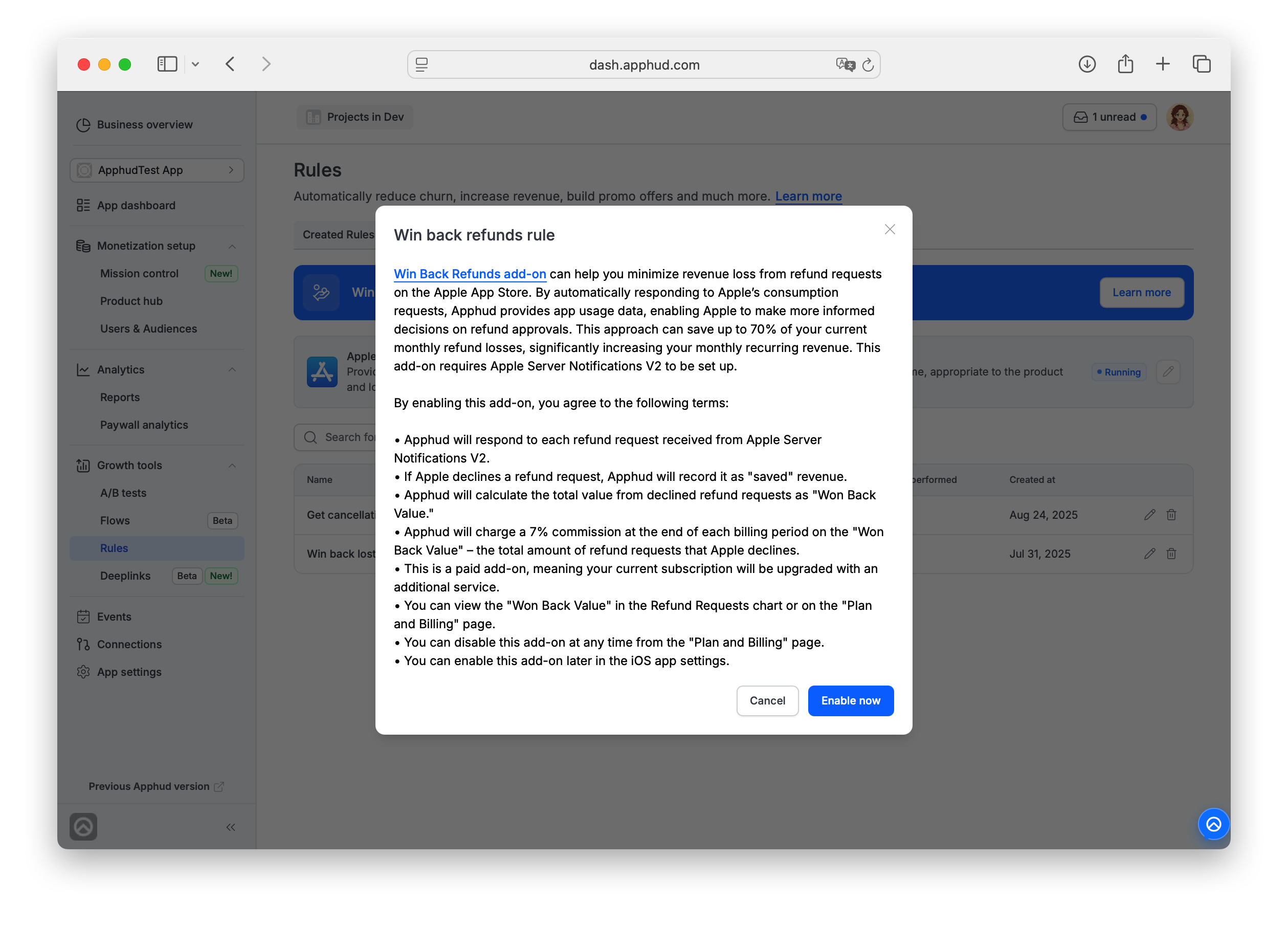
Win Back Refunds add-on can help you minimize revenue loss from refund requests. By automatically answering refund reviews, Apphud provides app usage data, enabling the store to make more informed decisions on refund approvals. This add-on requires server notifications to be set up. Supports both iOS and Android.
Terms
By enabling the add-on you agree that:
- Apphud will respond to each refund request received from Apple or Google server notifications.
- If the store declines a refund request, Apphud will record it as "saved" revenue.
- Apphud will calculate the total value from declined refund requests as "Won Back Value".
- Apphud will charge a 7% commission at the end of each billing period on the Won Back Value — the total amount of refund requests the store declines.
- This is a paid add-on — your current subscription will be upgraded with this additional service.
- You can view the Won Back Value in the Refund Requests Report and on the Plan and billing page.
- You can disable this add-on at any time from the Plan and billing page.
- You can enable this add-on later in the app settings if you skip now.
Click Enable now to activate.
Configure the rule
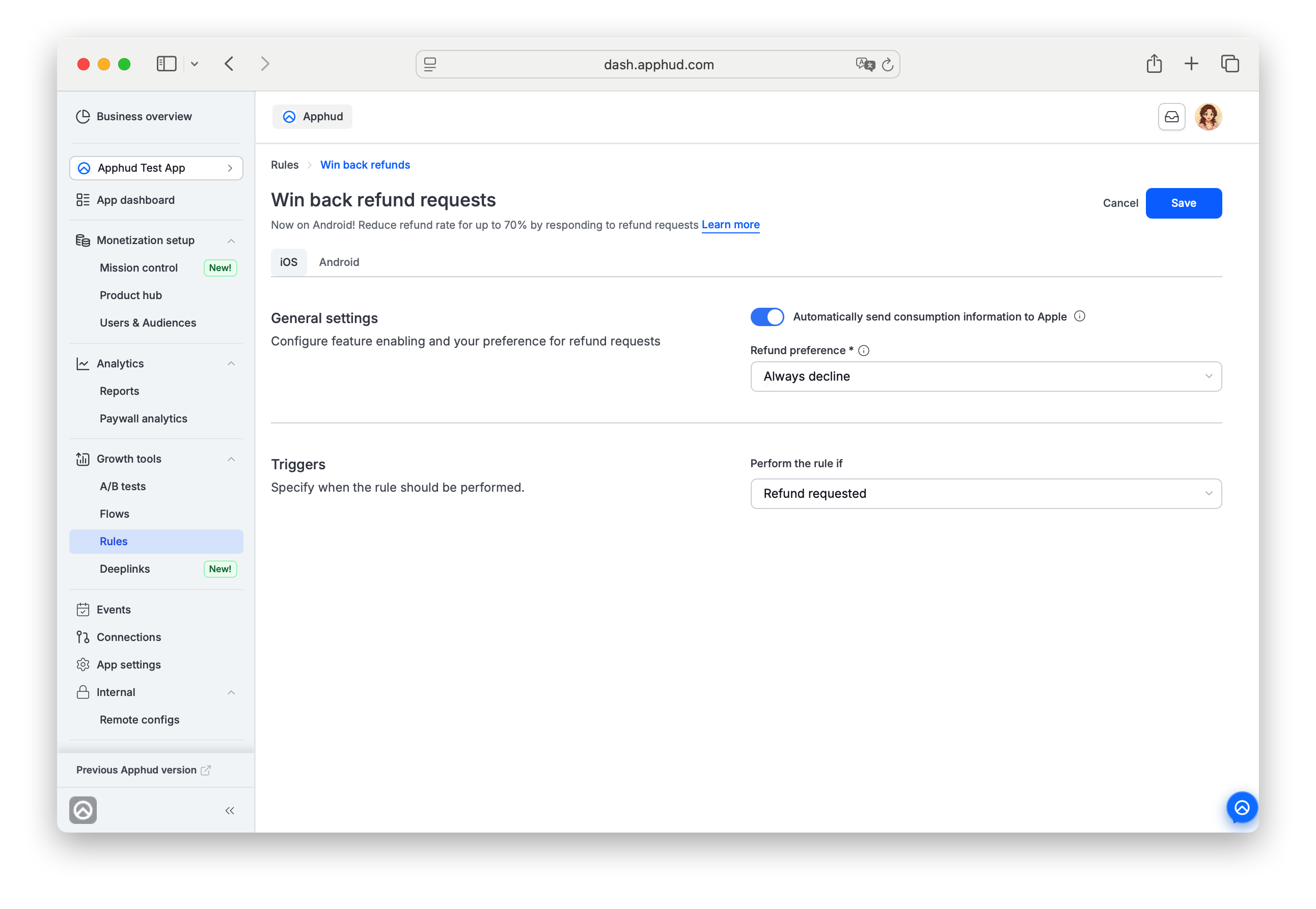
Once enabled, click the ✏️ pencil icon on the featured card to open the configuration page.
Breadcrumb: Rules > Win back refunds. Top-right buttons: Cancel + Save.
The rule has iOS and Android tabs — configure each platform separately.
General settings
Configure feature enabling and your preference for refund requests.
iOS:
- Automatically send consumption information to Apple — toggle. ON = Apphud responds to refund requests; OFF = no response is sent.
- Refund preference * — what recommendation Apphud sends with the consumption data:
- Auto (default) — Apphud picks the recommendation based on usage patterns.
- Undeclared — no preference attached; Apple decides without a hint.
- Always approve — recommend approving the refund.
- Always decline — recommend declining the refund.
- No preference — explicit "no preference" signal.
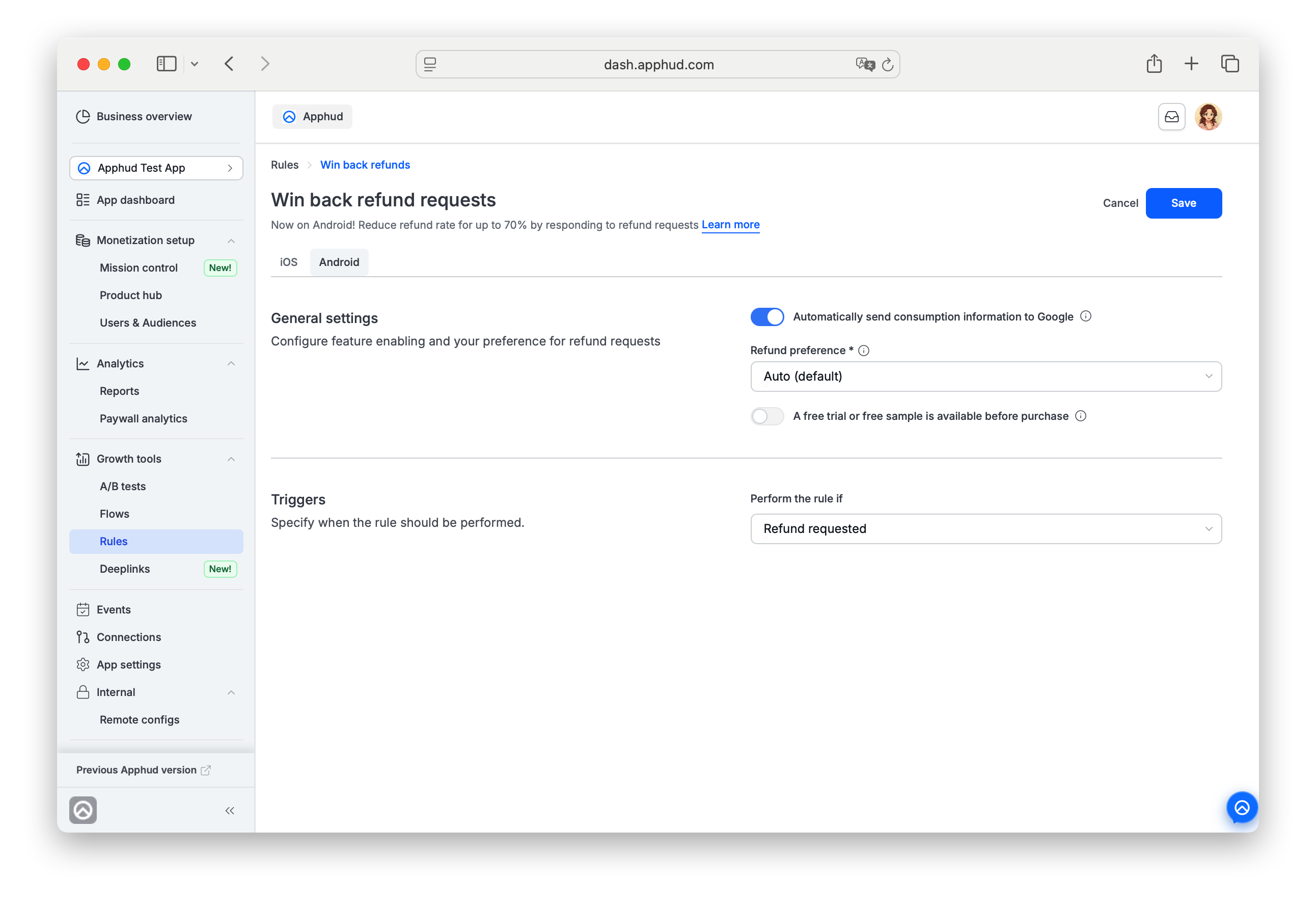
Android:
- Automatically send consumption information to Google — toggle. ON = Apphud responds to chargeback reviews; OFF = no response is sent.
- Refund preference * — four options, one fewer than iOS (there's no Android equivalent of "Undeclared"):
- Auto (default) — Apphud picks the recommendation based on usage patterns.
- Approve — recommend approving the refund.
- Decline — recommend declining the refund.
- Neutral — explicit "no preference" signal.
- A free trial or free sample is available before purchase — toggle. ON = tells Google a free trial or sample was available before the purchase; this factors into the consumption data sent with the chargeback response.
When turned OFF - Apphud will still send this as true only for disputes where that specific customer's own purchase history includes a trial.
Triggers
Specify when the rule should be performed.
- Perform the rule if — fixed at Refund requested. Cannot be changed; the rule reacts automatically to the
refund_requestedevent on iOS, and to Google's pending chargeback review notification on Android.
How the response works
iOS
When Apple sends a CONSUMPTION_REQUEST notification for a refund request that should be responded within 12 hours:
- Apphud verifies the rule is enabled for iOS and Server Notifications V2 is wired up.
- Apphud assembles consumption data: subscription history, usage patterns, account age, lifetime spend, etc.
- Apphud submits the data with your selected Refund preference to Apple.
- Apple makes its decision and sends the outcome via Server Notifications.
- Apphud logs the outcome and updates the Won Back Value if the refund was declined.
The end-user sees the standard App Store refund flow with no Apphud involvement — only Apple's decision is visible to them.
Android
For Android, Apphud reacts to Google's pending chargeback review notification — a dispute the customer opened through their bank. It does not cover self-service refunds a customer requests directly in the Play Store; Google doesn't expose those to developers as contestable. Google gives developers a limited window to respond to a chargeback review - 24 hours; Apphud processes these with priority to reply in time:
- Apphud verifies the rule is enabled for Android.
- Apphud assembles consumption data: subscription history, usage epizodes, etc.
- Apphud submits the data with your selected Refund preference and Trial or sample provided to Google. With Auto, Apphud weighs how much the customer has genuinely used the subscription since it started: no real usage leans toward a neutral signal, while meaningful usage shifts the recommendation toward decline, with supporting usage evidence attached whenever there is any to show. Decline always signals full consumption regardless of usage — usage evidence is attached whenever available, even a single session. Approve and Neutral never attach usage evidence.
- Google makes its decision and does not send the outcome. Apphud checks within 7 days if there is a refund and cancellation in receipt and repeats the checks up to 30 days.
- Apphud logs the outcome if no signs of refund and updates the Won Back Value if the refund was declined.
The end-user sees the standard Google Play dispute flow with no Apphud involvement — only the outcome is visible to them.
Events and Reporting
Refund events are logged in real-time, giving you immediate visibility into user refund requests and the store's decision outcomes.
When Win back refunds is enabled, refund requests declined by the store are marked with the "Managed by Apphud" reason — indicating that Apphud's automatic consumption data sharing influenced the outcome.
A dedicated Refund Requests Report is available only for apps with Win back refunds enabled. It aggregates refund data to help you track:
- The count and monetary value of refund requests.
- Approval and decline rates for submitted refunds.
- Average processing time for the store to resolve refund requests.
- Median time from purchase to refund request.
You can also see the impact of Win back refunds on your overall Refund Rate and refund volume using standard Apphud charts.
Commission and billing
- The Won Back Value is the cumulative amount of refund requests the store declined while the add-on was active.
- At the end of each billing period, Apphud charges 7% commission on the Won Back Value.
- You can see the current Won Back Value at any time on Plan and billing and in the Refund Requests Report.
Disable
To stop responding to refund requests, open the rule from the Win back refund requests card on the Rules page, toggle Automatically send consumption information to Apple OFF in General settings, and click Save. Apphud immediately stops sending consumption data for new refund requests.
Once disabled:
- The configuration is preserved — flip the toggle back ON anytime to resume.
- Any Won Back Value already recorded stays in your billing history and the Refund Requests Report.
Cancel the paid add-on (organization-wide)
The toggle above only stops sending consumption data for one app. To end the Win Back Refunds add-on for the entire organization — and stop its usage fee — make adjustments on Plan and billing.
Key benefits
- Automated refund handling — eliminates manual responses, faster and more efficient refund resolution, protected from human errors.
- Time efficiency — frees your team to focus on core business tasks without interruptions from refund management.
- Revenue protection — prevents unnecessary refunds from slipping through, safeguarding monthly recurring revenue.
- Mitigation of refund abuse — identifies and addresses patterns of refund abuse so requests are legitimate.
- Enhanced customer experience — timely and professional responses to refund requests improve user satisfaction.
Win back refunds also opens retention opportunities — instead of just declining a refund, you can set up Apphud Rules to offer incentives like discounted products or other win-back offers.
FAQ
What if my app isn't configured with Server Notifications V2?
The refund flow uses Apple's V2 notification format. Without V2 configured in your Apple Developer account and Apphud, the CONSUMPTION_REQUEST notification never reaches Apphud, so no consumption data can be sent. Configure SN V2 first — see Server Notifications. Reach out to Apphud Support if you need assistance.
Can I use this feature for Google Play refunds?
Yes, for chargebacks — disputes a customer opens through their bank. Apphud responds to Google's pending chargeback review the same way it responds to Apple refund requests, using real usage data. Self-service refunds a customer requests directly in the Play Store aren't covered — Google doesn't expose those to developers as contestable.
How can I obtain user consent for data sharing?
Through an opt-in or opt-out approach:
- In-app consent prompt that explains data usage and requires explicit user action (opt-in). If a user ignores or denies the request, treat them as not consented.
- Data-sharing clause in your Terms of Service stating that users consent by accepting the terms, with a clear opt-out procedure. After opt-out, treat the user as not consented.
Example clause (opt-out approach):
If we receive a refund request for an in-app purchase from an end user, we reserve the right to provide Apple with information regarding the user's in-app purchase consumption. This includes the following data: app usage time, anonymous account identifier, the total amount spent, and the total amount refunded.
You can additionally set up a Rule in Apphud to notify a user once they submit a refund request that their consumption information will be shared with Apple per your Terms of Service. See Apple's official documentation for details.
Will using this feature impact my app's performance?
No. The feature operates server-side and does not affect your app's performance or user experience.
What user data does Apphud share with Apple?
Apphud shares information as required by Apple's guidelines: an anonymized user ID, confirmation of user consent for data sharing, current user status, duration of app usage, level of purchase usage, total spending and refunds by the user, app usage time, whether the user had a trial, and other details.
Can I customize the data sent to Apple during a refund request?
No. Apphud automatically compiles and sends the consumption data based on the user's interaction with the in-app purchase. This ensures Apple receives accurate and comprehensive information to assess the refund.
What's the difference between **Auto** and **No preference**?
- Auto — Apphud analyses the user's usage patterns and submits a preference (approve / decline) based on what's most likely beneficial for both sides.
- No preference — Apphud submits the consumption data but explicitly tells Apple "we have no preference". Apple decides purely from the consumption data and Apple's own logic.
Can I change my Refund preference mid-billing-cycle?
Yes. The change applies to refund requests received from the moment you Save. Requests already processed in this cycle keep the preference they were submitted with.
Will the user see that I'm responding?
No. The Apphud response to Apple happens server-side. The user sees only the standard App Store refund flow and Apple's final decision.
Why don't I see refunds that were declined reflected in MRR?
Declined refunds mean the store kept the user's payment — your revenue is unchanged from where it was before the refund request. The "saved" amount shows on the Won Back Value, not as a separate MRR event.
How can I deactivate Win back refunds for an app?
See Disable. Short version: toggle Automatically send consumption information to Apple OFF in the rule's General settings, then save.
Updated 9 days ago