
Get Cancellation Insights
Turn cancellations into insight — ask churning users why they left with an in-app survey, capture each answer on the rule, and act on the reason.
Get Cancellation Insights is a Rules template that asks users why they cancelled — sending a push and presenting an in-app survey/feedback screen, then recording each answer against the rule so you can see why users leave and act on it.
The moment someone cancels is the single best chance to learn why — and most apps waste it. A cancellation you understand becomes a retention roadmap (onboarding fixes, pricing tests, bug triage) and lets you respond with the right save offer instead of a generic one.
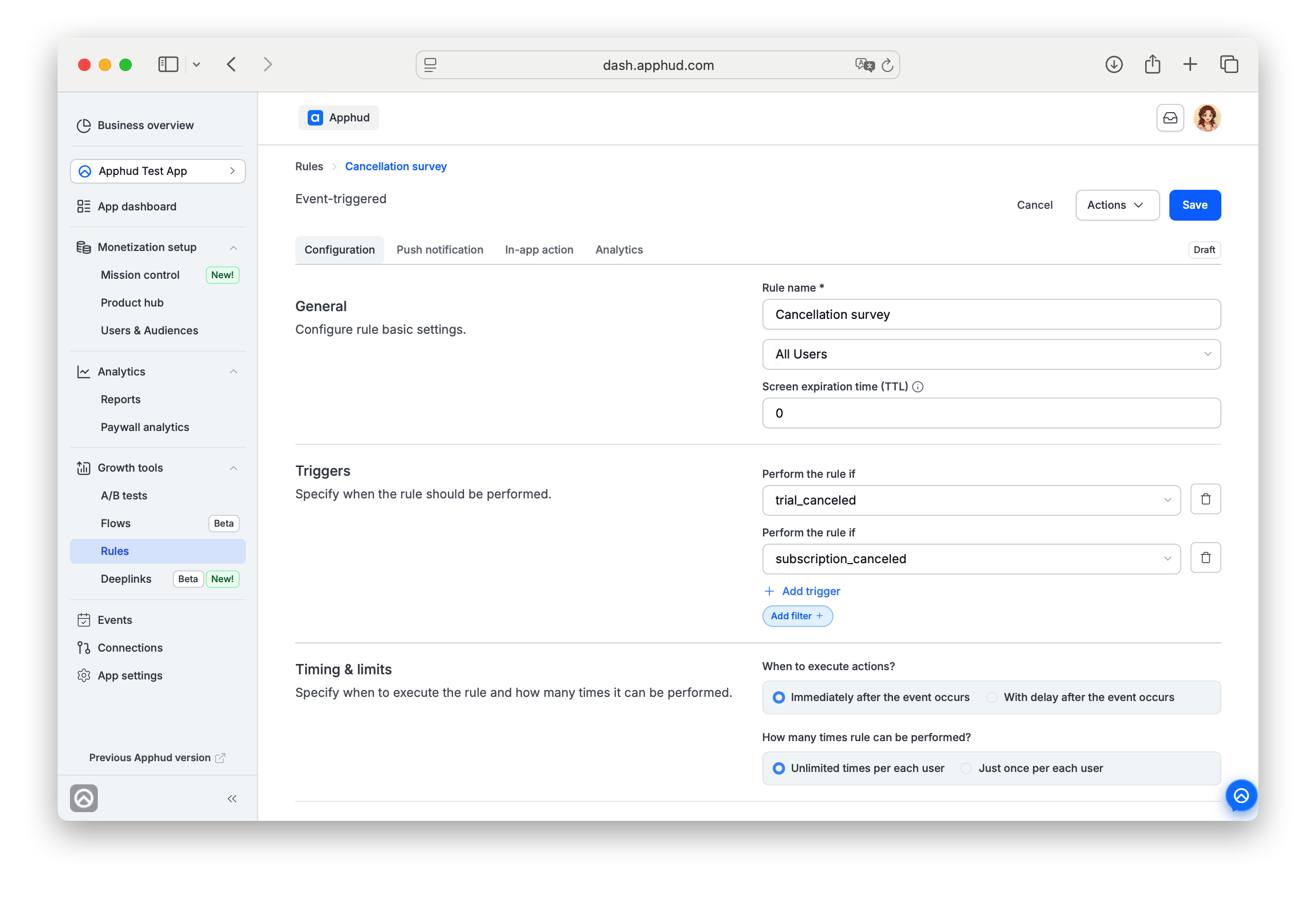
Find it under Templates on the Rules page — two variants ship:
| Template | Trigger | Use it for |
|---|---|---|
| Cancellation survey | trial_canceled, subscription_canceled | Surveying both trial and paid cancellations. |
| Get cancellation feedbacks | autorenew_disabled | The broad "auto-renew turned off" signal. |
How it works
- The user cancels → Apphud fires the rule and sends a push immediately.
- On the next app launch, the built-in survey screen appears asking "Why did you cancel?".
- Each answer the user taps is recorded against the rule.
- You review the results on the rule — each question with a breakdown of answer counts — and branch users to a tailored follow-up screen.
Where the answers goEach answer is recorded against the rule. Open the rule to see the survey results — every question with a breakdown of how many users chose each answer. These are internal survey records, not custom events in the Events stream, so you can't filter the Events page, send them to integrations, or trigger other rules on them.
Designing the survey
A leaving user won't fill out a long form — keep it sharp:
- 1–3 questions, max. The three highest-value ones: why did you cancel, what did you like, what could we do better.
- Lead with multiple choice, add one optional free-text box for nuance.
- Branch on the answer. Multiple-choice → tailored follow-up screen. You can build multi-screen surveys by connecting screens — each chosen answer can push the next screen in the flow.
Default cancellation reasons
Use these as your multiple-choice options — they cover the bulk of real-world churn:
| Reason | What it usually signals |
|---|---|
| Not using it enough | Activation / onboarding problem — the user never built the habit. |
| Too expensive | Usually perceived value, not pure price. |
| Billing / payment issue | Often involuntary churn — see Reduce Involuntary Churn. |
| Found a better app | Unmet expectations or a missing feature. |
| Technical issues / bugs | Trust erosion. |
Act on the answer
The core principle: personalize the response to the stated reason — a generic "we miss you" underperforms.
| Answer | Follow-up |
|---|---|
| Too expensive | A discount / win-back promo offer, a cheaper tier, or an annual plan. |
| Not using it | Re-onboarding, a value reminder, or a cheaper plan instead of a full cancel. |
| Bug / technical | Route to support, acknowledge, give a fix timeline. |
| Found alternative | Highlight differentiating or newly shipped features. |
| Billing | Dunning + update-payment prompt — see Reduce Involuntary Churn. |
And feed the aggregate back into the roadmap: if one reason spikes, you've found your next retention project. (Apphud's own example: feedback surfaced "lack of motivation," which led the team to add gamification and personalized content.)
Set it up
- Open Templates on the Rules page and Add rule on Cancellation survey (or Get cancellation feedbacks).
- Configuration — confirm the trigger and pick an audience if needed.
- Push notification — write the prompt that brings the user back to answer (per locale).
- In-app action — the built-in survey screen is attached automatically. Connect follow-up screens for branching if you want.
- Save, then Enable.
Survey recipes
A — Price sensitivity → win-back
Reason "Too expensive" branches to a win-back paywall with a promotional offer (or a cheaper/annual plan). The answer is recorded on the rule for later analysis.
B — Low usage → re-onboarding
Reason "Not using it enough" branches to a value reminder that highlights a key feature they haven't tried yet, or a cheaper plan.
C — Bug → support + roadmap signal
Reason "App was buggy" branches to a free-text "What broke?" + a Contact-support button; the responses feed support and engineering.
Best practices
- No dark patterns. Don't hide the cancel button or guilt-trip — it backfires in reviews. The survey is for learning, not trapping.
- Don't over-ask. Completion collapses on the exit screen; structured options beat a wall of free text.
- Always act. Answers that don't route to an offer or the roadmap are wasted.
FAQ
What's the difference between "Cancellation survey" and "Get cancellation feedbacks"?
Same goal, different trigger. Cancellation survey fires on trial_canceled / subscription_canceled; Get cancellation feedbacks fires on autorenew_disabled. Pick whichever signal matches when you want to ask.
Where do the survey answers go?
Each answer is recorded against the rule. Open the rule to see the survey results — every question with its answer-count breakdown. They're internal survey records, not custom events in the Events stream, integrations, or rule triggers.
Can the survey have more than one question?
Yes. Connect multiple screens — a tapped answer pushes the next screen, so you can branch (e.g. "Too expensive" → "What would make it worth it?").
Can I both survey and make an offer in one flow?
Yes — branch from the reason screen to a win-back offer screen for the answers where an offer makes sense (e.g. price).
Learn more
- Understanding Rules in Apphud — cancellation feedback in context.
Updated 12 days ago