
TikTok Events API
This guide describes how to add and configure TikTok Events API integration.
The TikTok Events API integration is a Server-to-Server (S2S) connection that shares website and app visitor events directly with TikTok. It's designed for Web-to-App and Web-to-Web (Flows) campaigns running in TikTok with event optimization.
Using TikTok Events API for Web-to-App and Web-to-Web campaigns
TikTok Events API is useful when running Web-to-App or Web-to-Web (Flows) campaigns in TikTok with event optimization.
A Web-to-App campaign is a web campaign targeted at your app's landing page, which has a link to the App Store.
This integration is part of the Web-to-App and Flows (Web-to-Web) solution. See the Web-to-App step-by-step guide for the full setup.
Requirements
- TikTok Pixel.
- Access Token for TikTok Pixel.
- Landing page with installed TikTok and Apphud scripts.
How to Add Integration?
Step 1 - Preparations in TikTok
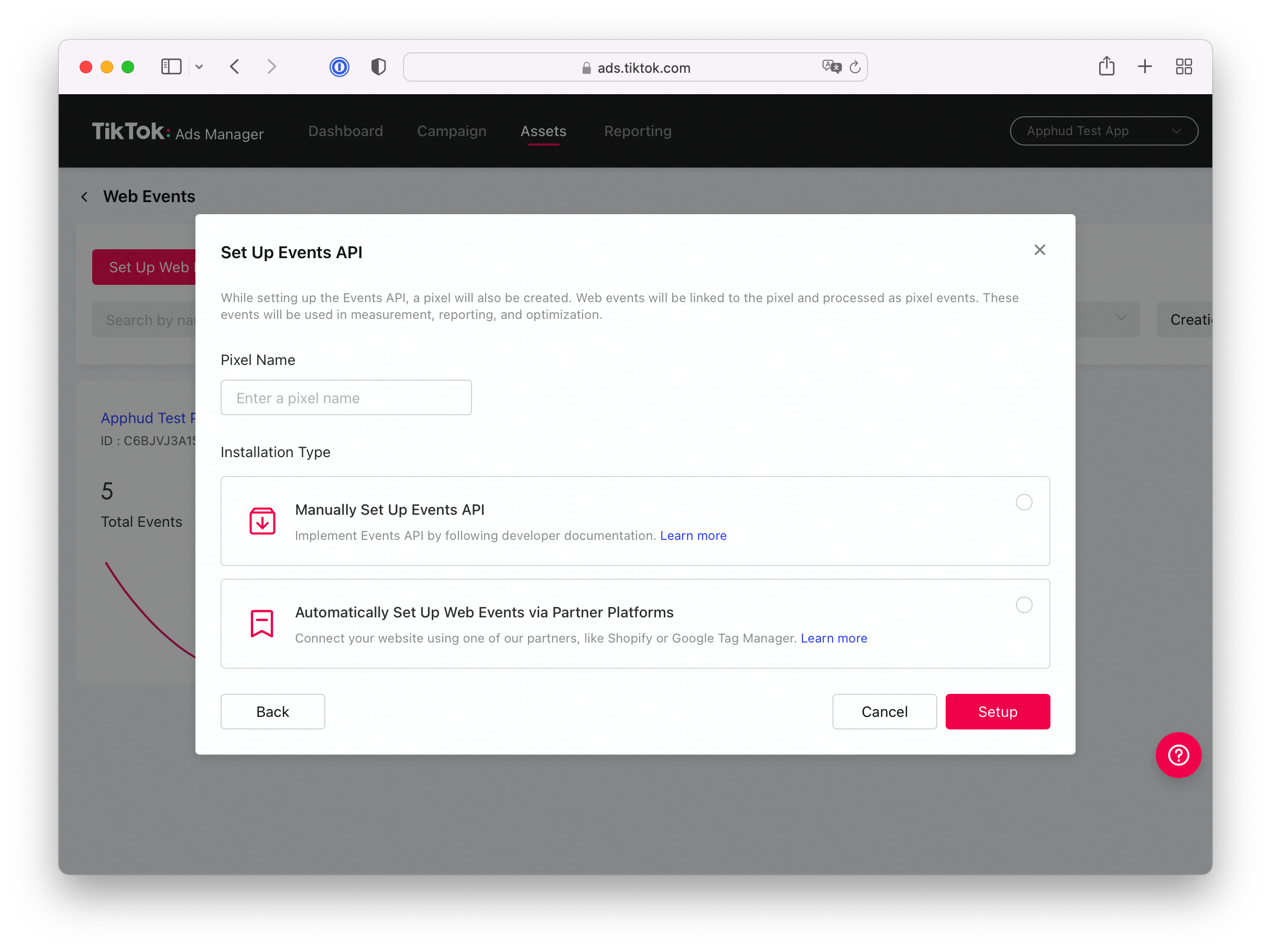
Create Pixel in developer mode
In TikTok Ads Manager, create a Pixel as per TikTok documentation in developer mode:
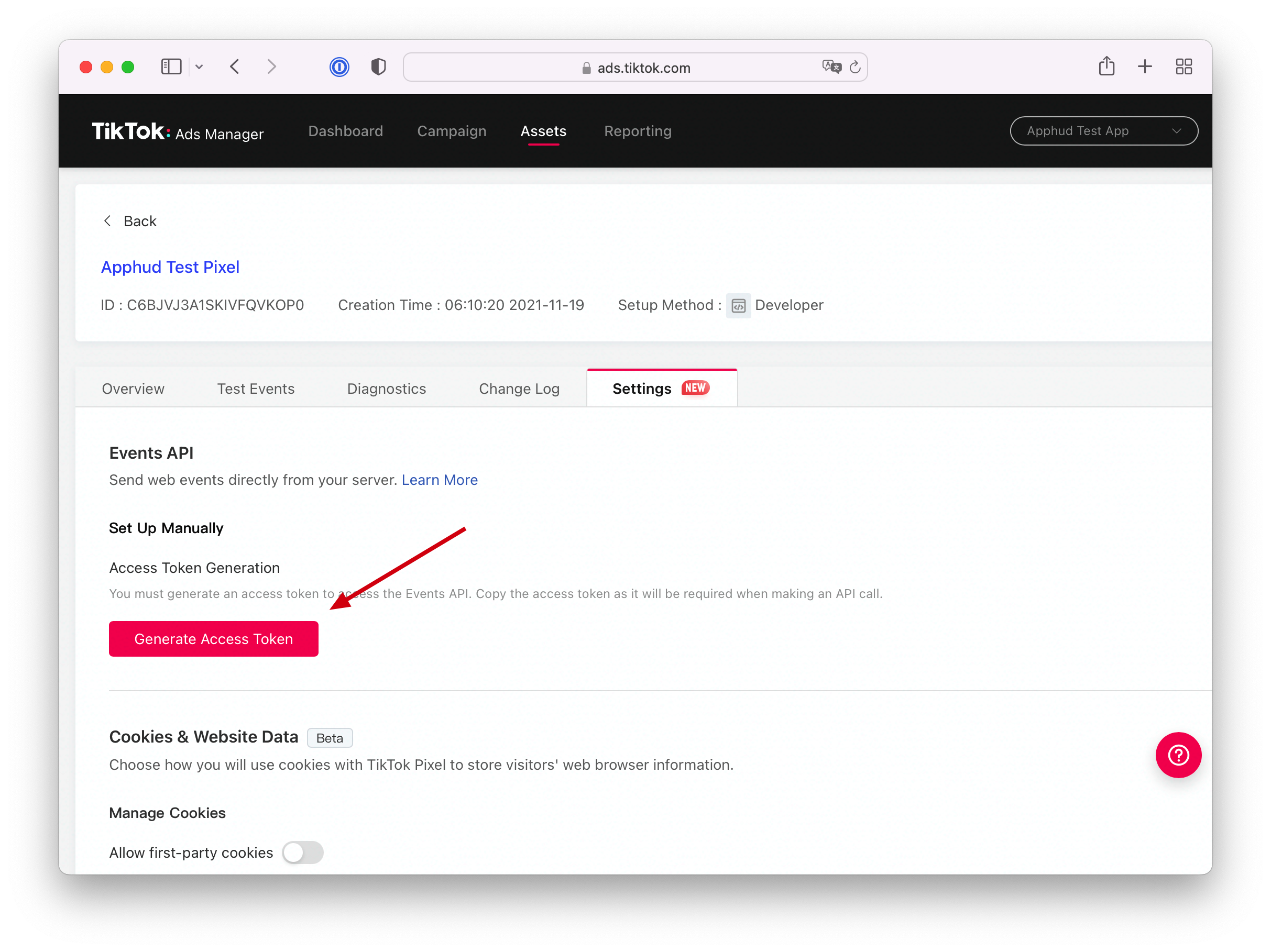
Generate Access Token
In Pixel settings, generate an Access Token:
Step 2 - Authentication
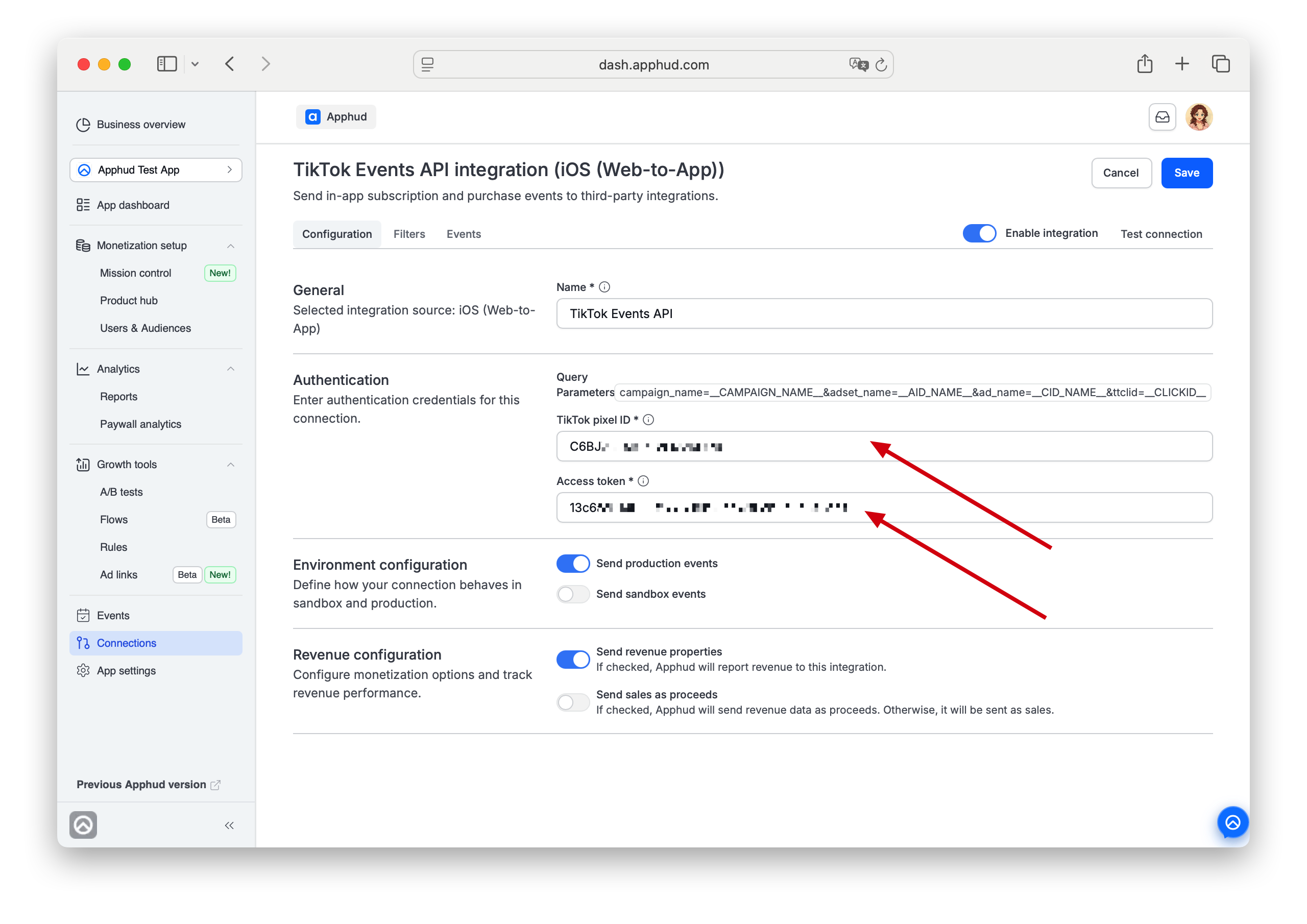
In Apphud, open Connections → Integrations (the All or Attribution tab). Click Add Connection for TikTok Events API and choose a Source in the pop-up.
Enter:
- Pixel ID (required) — your TikTok Pixel ID.
- Access Token (required) — generated in Step 1.
Step 3 - Additional Configuration
Environment and Revenue
Configure generic Environment and Revenue settings as described on Integrations overview → Configuration tab.
Set up filters (optional)
Navigate to Filters tab. Set up filters if needed as described on Integrations overview → Filters tab.
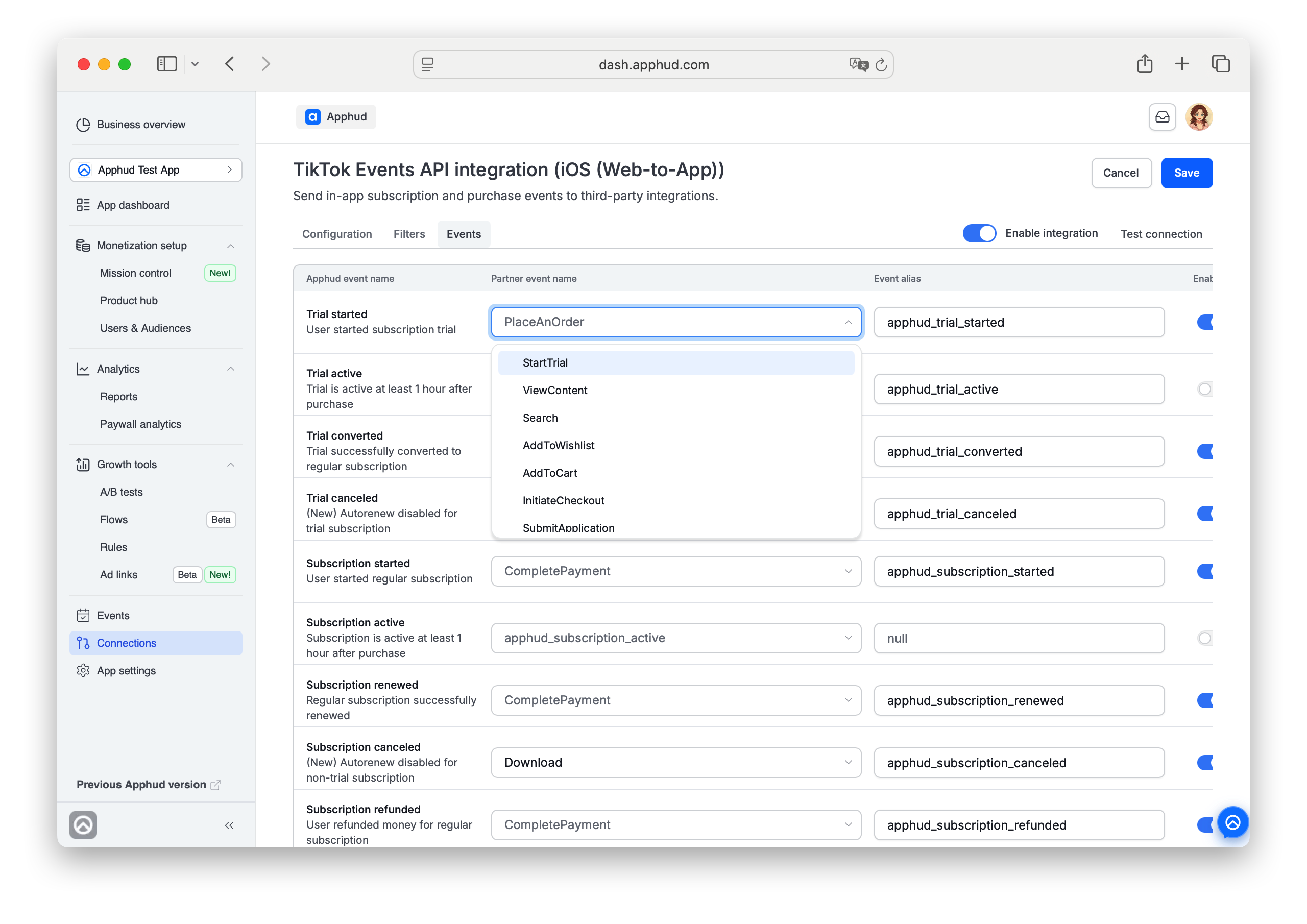
Step 4 - Set up Events list
Open the Events tab of the configuration. Disable unnecessary events or change event names.
Step 5 - Test connection (optional)
Save the connection.
For the general integration configuration testing flow see Integrations overview → Test connection.
Step 6 - Enable and save
Click Enable integration and Save.
Step 7 - Add URL parameters to your TikTok campaign
When creating a campaign in TikTok Ads Manager, you must add URL Query parameters displayed on the TikTok integration page in Apphud. Click on the field in Authentication section to copy it:
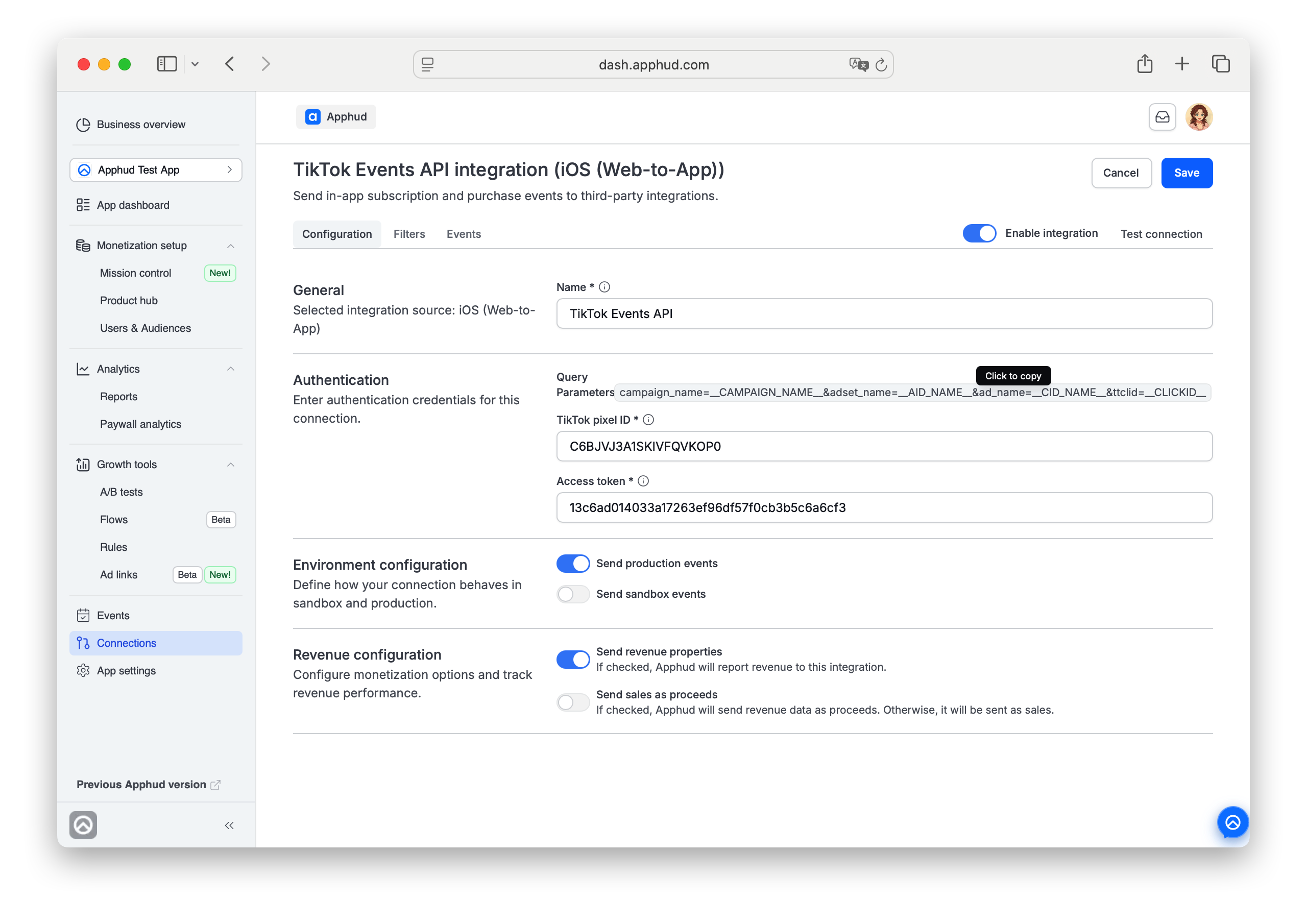
See Tracking Attribution Data below for the parameter list and examples.
Tracking Attribution Data
To track attribution, add URL query parameters to your advertising URL.
Example:
campaign_name=__CAMPAIGN_NAME__&adset_name=__AID_NAME__&ad_name=__CID_NAME__&ttclid=__CLICKID__Final Ad URL Example
Using Apphud's Landing Page (Web-to-App):
https://yourapp.siiites.com/?campaign_name=__CAMPAIGN_NAME__&adset_name=__AID_NAME__&ad_name=__CID_NAME__&ttclid=__CLICKID__Using Your Own Website:
https://yourownwebsite.com/?campaign_name=__CAMPAIGN_NAME__&adset_name=__AID_NAME__&ad_name=__CID_NAME__&ttclid=__CLICKID__For further details, see this TikTok guide (scroll to the bottom) and the TikTok API documentation.
Attribution Parameter Mapping
You can replace campaign_name, adset_name, and ad_name with alternative UTM parameters for campaign attribution. The mapping options are:
- Campaign Name — one of:
campaign_name,utm_campaign,c. - Adset Name — one of:
utm_content,adset,adgroup,adgroup_name,af_adset,adgroup_id. - Ad Name — one of:
utm_term,adname,ad,ad_id,ad_name,af_ad.
Analyze TikTok campaigns in Apphud
Since the integration is part of the Web-to-App solution, analytics is described in Ad Analytics.
Updated 3 months ago