
Renewals Performance
Detailed analysis of paid-subscription renewals, billing issues, and recovery effectiveness.
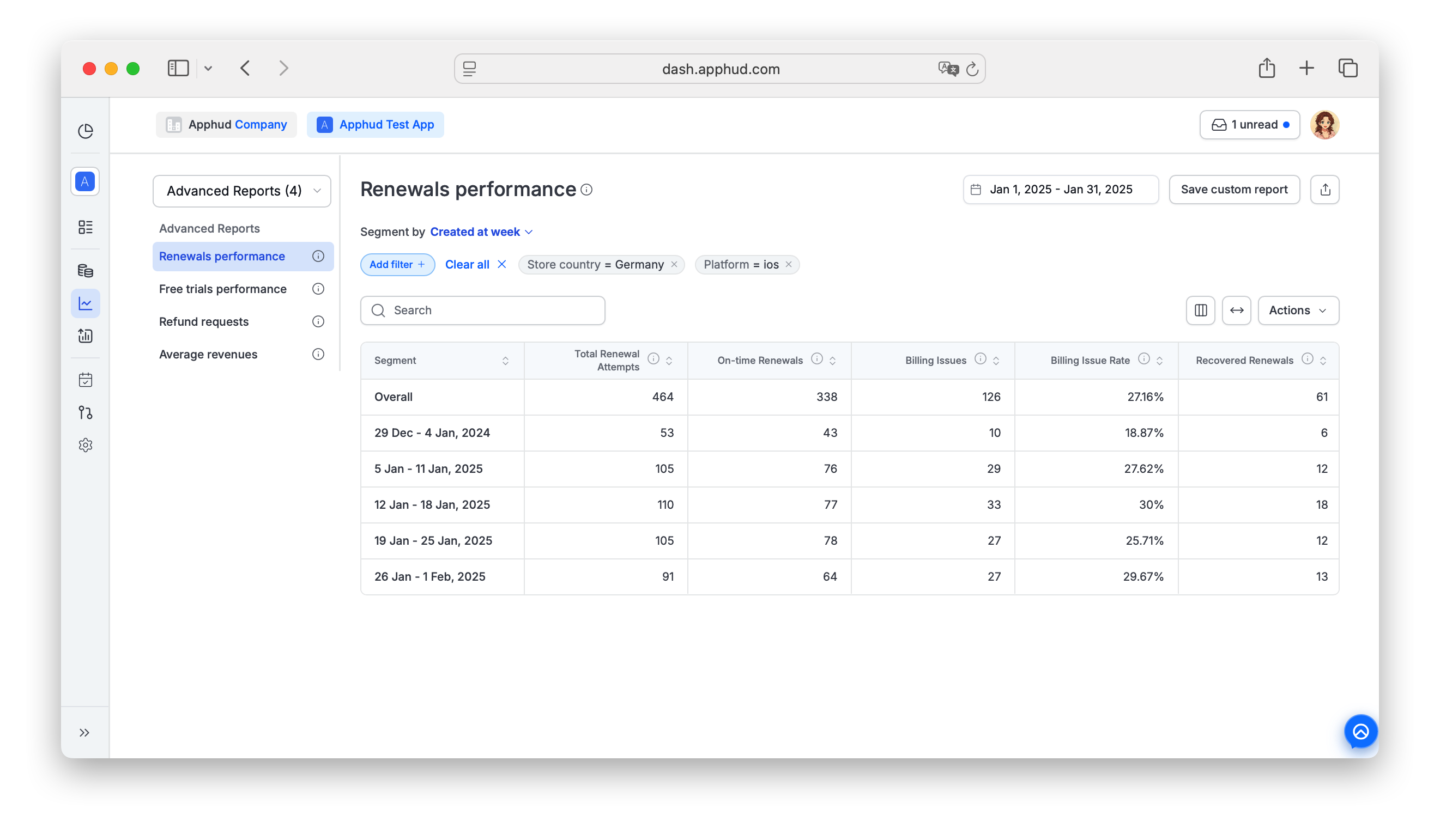
Renewals Performance provides a comprehensive analysis of subscription renewals, billing issues, and the effectiveness of recovery mechanisms for paid subscriptions within a date range.
Use it to understand how effectively paid subscriptions recover after a billing issue across products and countries, and estimate potential revenue from recovered subscriptions.
Find Renewals Performance under Analytics → Reports → Advanced Reports in the sidebar.
Real-world use caseWalkthrough on acting on this report: Path to subscription-renewals mastery.
Data availability
Data for this report is available starting from August 10, 2024.
The selected date range applies to Total Renewal Attempts, On-Time Renewals, and Billing Issues. Other cohort metrics (recovery counts, recovery rates, cancellations) depend on these three and are not date-bounded.
Segments such as "Created on day / week / month / quarter / year" apply to renewal attempts, not to user creation date.
Platform support
Both iOS and Android are supported. Two metrics are iOS-only due to platform limitations:
- Recovered with Promo Offer
- Recovered with Different Product
Rows with zero renewal attempts (zero on-time renewals + zero billing issues) are excluded from the table.
Metrics
Toggle metric visibility from the columns menu. The report includes:
Metric order here vs. in the reportThe metrics below are grouped by type (Volume, Rates, Recovery, …) for readability.
This is not the left-to-right column order in the report.In the report itself, columns follow the renewal lifecycle: Total Renewal Attempts → On-Time Renewals → Billing Issues → Billing Issue Rate → Recovered Renewals → Billing Recovery Rate → Total Renewal Rate → Pending Billing Issues → Canceled from Billing Issues / Grace Period / Billing Retry → Recovered from Grace Period → Grace Period Recovery Rate → Recovered from Billing Retry → Billing Retry Recovery Rate → Recovered with Promo Offer → Recovered with Different Product → On-Time Renewal Rate → Average Billing Recovery Time.
Note that the rate metrics are interleaved with their counts in the report, whereas the groups below collect all rates together.
Volume
- Total Renewal Attempts — total subscription renewal attempts in the period (on-time renewals + billing issues).
- On-Time Renewals — successful renewals in the period (includes trial conversions and Google Play resume-from-pause). Excludes initial purchases and user-initiated transactions like prorated upgrades — only background renewals count.
- Billing Issues — count of Billing Issue events in the period. Each event is unique per subscription period — it does not represent every bank charge attempt.
Use CaseHow well the subscription price fits a specific user audience?
On-time renewals may vary based on the product price and country. A higher On-Time Renewal Rate corresponds to a lower Billing Issue Rate, reflecting better alignment between pricing and user affordability.
This metric excludes all user-initiated purchases, as only "background" renewals can encounter billing issues.
Rates
- On-Time Renewal Rate (%) — On-Time Renewals / Total Renewal Attempts.
- Billing Issue Rate (%) — Billing Issues
- Total Renewal Rate (%) — (On-Time Renewals + Recovered Renewals) / Total Renewal Attempts.
- Billing Recovery Rate (%) — Recovered Renewals / Billing Issues.
- Grace Period Recovery Rate (%) — Recovered from Grace Period / Billing Issues.
- Billing Retry Recovery Rate (%) — Recovered from Billing Retry
Use CasesHow bad the subscription price fits a specific user audience?
Billing Issue rates may vary based on the product price and country. A higher Billing Issue Rate corresponds to a lower On-Time Conversion Rate, reflecting worse alignment between pricing and user affordability.How effectively subscriptions recover after encountering a billing issue?
This can help estimate potential revenue from recovered subscriptions. Billing recovery rates may vary by product price and country, with a higher recovery rate indicating better alignment between pricing and user affordability.
Recovery
- Recovered Renewals — subscriptions recovered from any billing-issue state.
- Recovered from Grace Period — recoveries from Grace Period state.
- Recovered from Billing Retry — recoveries from Billing Retry state.
- Recovered with Promo Offer (iOS only) — recoveries via a Promo Offer.
- Recovered with Different Product (iOS only) — recoveries via plan switch (upgrade, downgrade, or crossgrade).
Use CasesHow effectively promotional offers are used to recover failed subscription renewals?
The success of Recovered with Promo Offer metric is very dependent on the specific offer, with better offers leading to a higher conversions.
This metric can be interpreted as the number of successful win-backs.How frequently users change their subscription plan in iOS settings when facing billing issues?
Users typically cancel their subscriptions in iOS settings during billing issues; however, some switch to a cheaper plan, like from yearly to monthly, or to a better value plan, like from weekly to yearly.
As a result, this metric can be interpreted as the number of successful win-backs among users who initially intended to cancel their subscription.
Cancellations
- Canceled from Billing Issues — total cancellations during any billing-issue state.
- Canceled from Grace Period — cancellations during Grace Period.
- Canceled from Billing Retry — cancellations during Billing Retry.
Use CaseHow many billing issues failed to recover?
Canceled from Billing Issues reflects billing issues that never recovered — useful for estimating revenue lost to unrecovered payment failures.
Other
- Pending Billing Issues — billing issues still pending resolution (Grace Period or Billing Retry, auto-renew still active).
- Average Billing Recovery Time — average hours to recover from a billing issue back to active paid state.
Pending Billing Issues affect downstream metricsSeveral metrics (Recovered Renewals, Billing Recovery Rate, Total Renewal Rate, etc.) can change as pending billing issues resolve. Treat very recent periods as preliminary until pending counts drop to zero.
Supported filters and segments
Renewals Performance supports all standard segments and filters documented in Reports → Filters and segments. The most useful segments are Product and Store Country.
"Created at" segment applies to renewal attempts"Created on day / week / month / quarter / year" segments apply to the date of the renewal attempt, not the user creation date.
Filter-only (not available as Segment by):
- Permission group — segment support is planned, currently filter only.
- Screen
- Experiment variations
Learn moreWalkthrough on acting on this report: Path to subscription-renewals mastery.
FAQ
What's the difference between Grace Period and Billing Retry?
- Grace Period — the subscription's billing failed, but the user retains access while the store retries the charge. Auto-renew is still on. Most apps configure 16 days for Grace Period.
- Billing Retry — the Grace Period ended without success and the store keeps retrying behind the scenes; access is lost but the subscription isn't fully canceled yet.
Recovery from either state generates a billing_issue_resolved event.
Why does Billing Recovery Rate keep changing for past periods?
Because pending billing issues from those periods are still resolving. A billing issue from last week might recover this week, retroactively bumping last week's recovery rate.
How do I find which products have the worst billing-issue rate?
Segment by Product and sort the table by Billing Issue Rate descending. Pair with segmenting by Store Country to see geographic affordability patterns.
Updated 24 days ago