
Refund Rate
Percentage of transactions refunded out of all paid transactions in the selected period.
Refund rate is a cohort chart that indicates the percentage of transactions that were refunded out of the total paid transactions billed during the selected period.
Refund rate = (Refunded transactions / All transactions in the period) × 100%
For example: if 100 transactions were billed to customers in November and 15 of them were refunded later, Refund rate for November is 15%.
Find Refund rate under Analytics → Reports → Money in the sidebar.
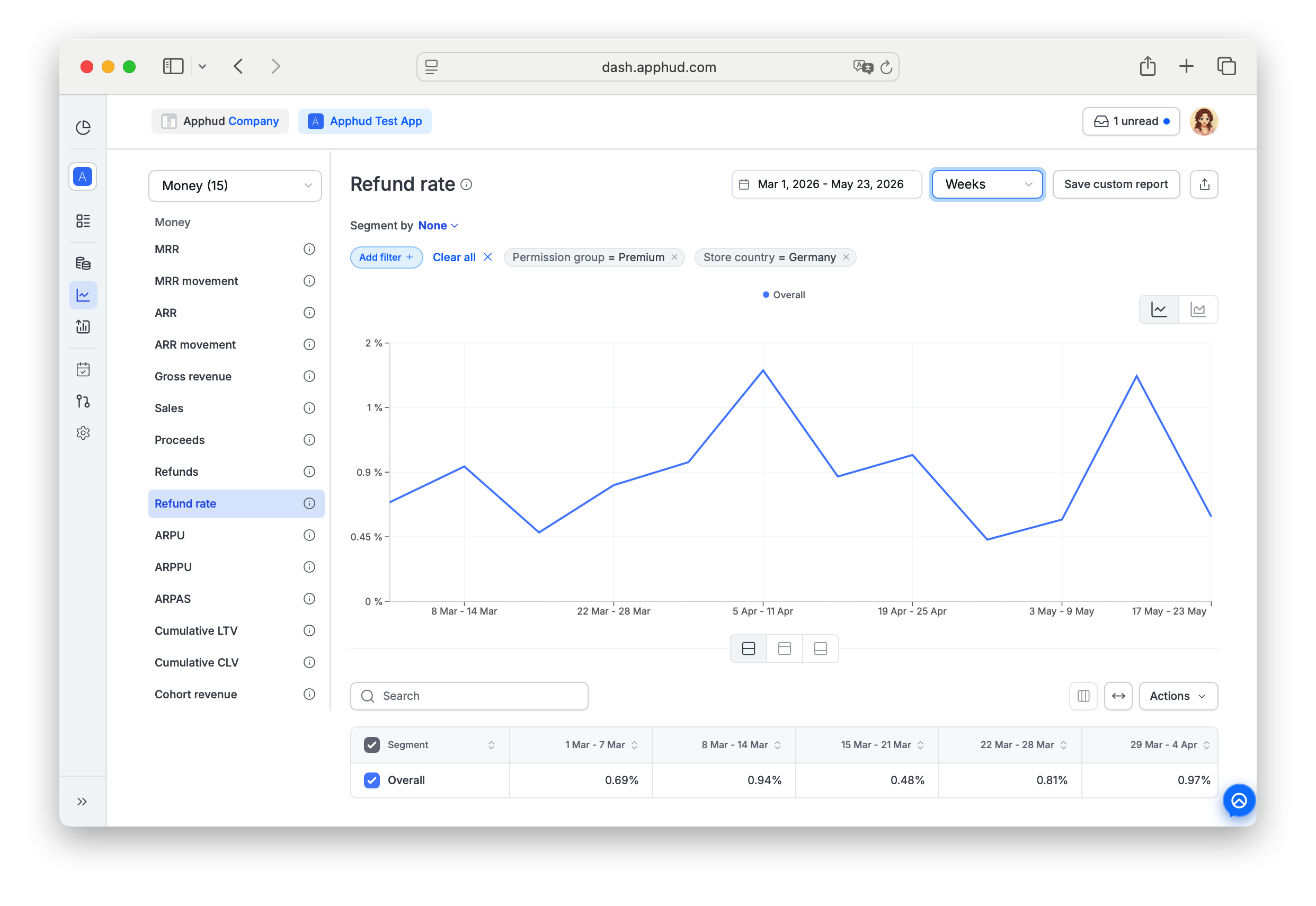
How Refund rate is counted
Refund rate is a cohort metric:
- Denominator — all paid transactions billed during the selected period (the cohort).
- Numerator — among those transactions, the count that has been refunded at any later point (including refunds processed after the original period).
Because refunds can come in late (users have weeks or months to request one), Refund rate for recent periods will continue to climb as more refunds are processed. The most recent month or two is therefore a rolling estimate — older months are more stable.
For the absolute refund amount (in money, not %), see Refunds. For the net revenue loss after commission and VAT, see Proceeds → Refunds Revenue Type.
Supported filters and segments
Refund rate supports all standard segments and filters documented in Reports → Filters and segments.
Filter-only (not available as Segment by):
- Permission group — segment support is planned, currently filter only.
- Screen
- Experiment variations
FAQ
Why does Refund rate keep changing for past months?
Because Refund rate is cohort-based on the original billing period. A refund processed today for a transaction billed three months ago retroactively increases that older period's refund rate. Older months stabilize once refund windows close; recent months keep moving.
Recent Refund rate looks suspiciously low — is something wrong?
Probably not — recent periods haven't accumulated their full refund count yet. Wait for the refund window to close (typically 30–90 days depending on the store) before treating a Refund rate as final.
What counts as a "transaction"?
Each billing event — initial purchase, renewal, intro/promo purchase. A monthly subscription renewing every month generates one transaction per renewal. A refund of any single transaction adds 1 to the numerator for that transaction's billing period.
How is Refund rate different from Sales − Gross revenue / Gross revenue?
That ratio measures the monetary share of refunds in the same period they were processed. Refund rate measures the share of cohort transactions that were eventually refunded, regardless of when the refund happened. The two answer different questions: one is "how big are this month's refund cash outflows" (monetary, period-of-refund); the other is "how often do customers refund what they bought" (count, period-of-purchase).
Updated 22 days ago