
MRR Movement
Breakdown of MRR changes — New MRR added vs Churned MRR lost — over time.
MRR Movement displays the changes in MRR over time, broken into two components:
- New MRR — recurring revenue added by new subscriptions, reactivations, and upgrades.
- Churned MRR — recurring revenue lost to expired subscriptions and downgrades.
Both values are calculated on the Proceeds metric (after store commission, refunds, and taxes).
Find MRR Movement under Analytics → Reports → Money in the sidebar.
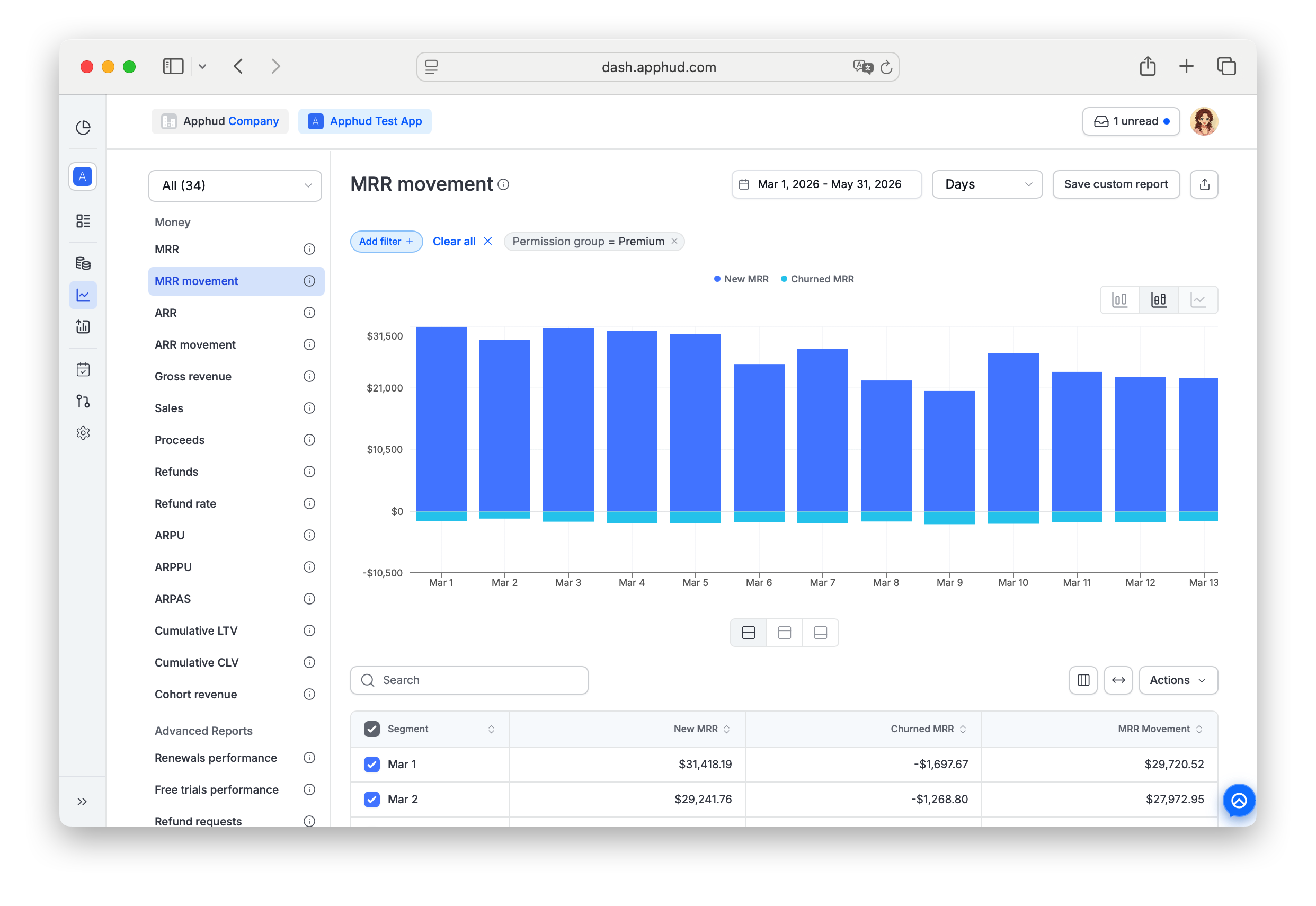
Why MRR Movement mattersMRR alone shows the total; MRR Movement shows what drove the change. Use it to separate growth (New MRR) from contraction (Churned MRR), spot trends in expansion vs. churn, and identify periods where one side dominates.
Calculation
| Bucket | What's included |
|---|---|
| New MRR | New subscriptions, reactivations of previously churned users, upgrades from cheaper to more expensive plans |
| Churned MRR | Subscriptions that expired in the period, downgrades from more expensive to cheaper plans |
Net MRR change for a period = New MRR − Churned MRR. The line connecting the bars shows the period-over-period delta.
All values normalized to a monthly amount, on the Proceeds metric. See About Analytics for the VAT and store-commission rules.
Supported filters and segments
MRR Movement supports all standard segments and filters documented in Reports → Filters and segments.
Filter-only (not available as Segment by):
- Permission group — segment support is planned, currently filter only.
- Screen
- Experiment variations
FAQ
What counts as an upgrade or downgrade?
A user switching from one paid product to another at a different price. Upgrade = moves to a more expensive plan, counted under New MRR (the delta added). Downgrade = moves to a cheaper plan, counted under Churned MRR (the delta removed). Switching between plans at the same price doesn't move MRR.
Why is Churned MRR larger than I expect?
Churned MRR includes both involuntary churn (expired subscriptions, e.g., from billing failures) and voluntary churn (cancellations whose paid period has now ended). It does not include subscriptions that are cancelled-but-still-active — those keep contributing to MRR until expiry. See MRR for the active-vs-expired logic.
How is reactivation counted?
A user who previously churned and then resubscribes is counted as New MRR in the period of reactivation — not as a continuation of their previous subscription.
Why doesn't New MRR − Churned MRR exactly match the MRR change between two periods?
Tiny rounding differences due to normalization can appear when comparing summed bars vs. point-in-time MRR snapshots, especially at week or month boundaries. For revenue planning, treat the chart as directionally accurate; for exact accounting, use Proceeds + receipts.
Updated 28 days ago